
The Fifth Industrial Revolution: Inside The Space Factories That Could Change Everything
Beyond the Postcard Image of London
When we picture an "Industrial Revolution," we usually imagine the same gritty aesthetic: black smoke billowing from Victorian chimneys, the roar of steam engines, or the hum of server farms cooling the early internet. We think of things that are heavy, loud, and firmly planted on the ground.
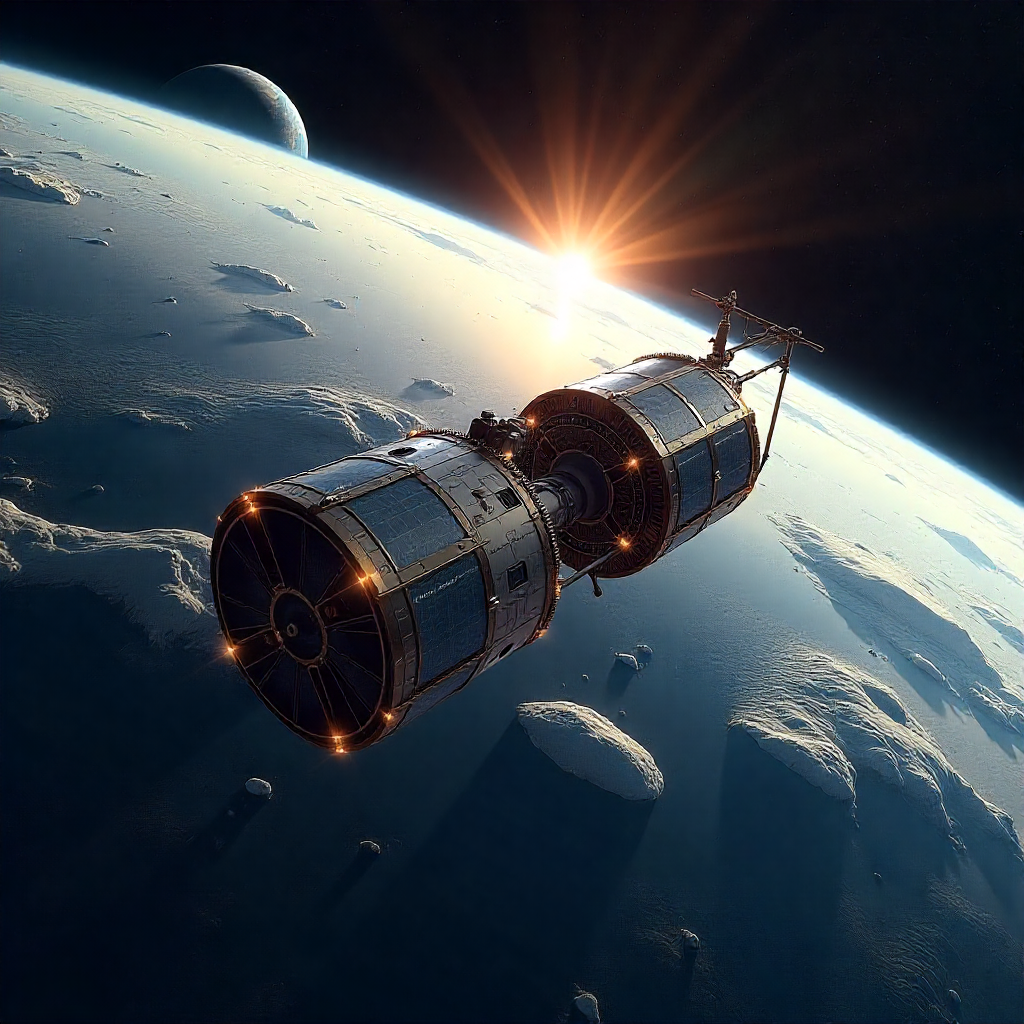
But the next Industrial Revolution? It isn’t happening here. It is happening in the silent, vacuum-sealed, zero-gravity world 250 miles above your head. And it is about to change the trajectory of our species forever.
For decades, space was a "destination" a place for flags, footprints, and national pride. Today, that era is dead. Space is now a place of business. We are witnessing the birth of the Celestial Industrial Complex, an economy projected to hit a staggering $1.8 trillion by 2035.
Here is why Earth’s manufacturing floor is moving to the sky, and why the "Impossible" is about to become "Routine."
The Death of the "Rocket Equation"
To understand the future, you have to understand the tyranny of the past. For the entire Space Age, we were held hostage by the "Rocket Equation." To get mass into orbit, you needed a mountain of fuel and disposable hardware.
- The Old Way: The Space Shuttle cost roughly $54,500 per kilogram to launch. Imagine buying a car, driving it once, and throwing it into the ocean. That was the space industry.
- The Disruption: Enter SpaceX. The Falcon 9 slashed that cost to ~$2,700/kg.
- The Future: Looming on the horizon is Starship. If successful, it promises to drop launch costs to $10 per kilogram.
This isn't just an improvement; it is a species-level unlock. At $10/kg, the economics of physics change. We stop building delicate, origami satellites and start launching massive steel structures, heavy machinery, and entire factories.
The Factory of the Impossible
Why build in space? It’s not just to save space on Earth. It’s because gravity is a contaminant. Down here, gravity ruins things. It causes sedimentation, convection, and buoyancy. It creates microscopic flaws in everything we make. But in the microgravity of orbit, those rules vanish. We can now manufacture materials that are literally impossible to produce on Earth.
- ZBLAN Fiber: This is fiber optic glass so pure it is 100 times more efficient than what runs the internet today. Made on Earth, it crystallizes and breaks. Made in space, it is perfect atomic harmony.
- The Organ Farm: On Earth, if you try to 3D print a human heart, it collapses under its own weight. In space, cells can be printed into complex vascular structures that hold their shape. We aren't just talking about research; we are talking about printing hearts, livers, and retinas for patients on Earth.
- Super-Crystals: Pharmaceutical giants are already using the ISS to grow drug crystals that are larger and more uniform than anything terrestrial labs can produce, leading to more potent, injectable treatments.
We are moving from exploration to production. The "Made in Space" label is about to become the ultimate seal of quality.
The Age of the Space Mechanic
The most mind-boggling shift, however, is in how we treat our gear. For 60 years, satellites were disposable. If a $500 million satellite ran out of gas, it became junk.
That ends now.
Welcome to the era of ISAM (In-space Servicing, Assembly, and Manufacturing).
- Roadside Assistance: We are building "tow truck" robots. We’ve already seen missions like the MEV (Mission Extension Vehicle) dock with dead satellites and act as a new jetpack, giving them years of extra life.
- Orbital Surgery: The future isn't a brave astronaut risking their life to fix a solar panel with wire ties (as happened on the ISS in 2007). The future is the Mission Robotics Vehicle, a fully autonomous robot with arms that can swap batteries, refuel tanks, and 3D print new parts in the void.
We are no longer just visiting orbit; we are settling in. We are building infrastructure.
The Trillion-Dollar Mines and Infinite Energy
If the factory is in orbit, where do the resources come from? Launching raw materials from Earth defeats the purpose. The answer lies in the "High Frontier."
- Asteroid Mining: There are rocks like 16 Psyche floating in the asteroid belt that contain enough iron, nickel, and gold to technically make everyone on Earth a billionaire (though basic economics would crash the market first).
- The Moon: The new space race isn't for prestige; it's for Water Ice at the lunar south pole. Water is the oil of the solar system. Split it, and you have Hydrogen and Oxygen rocket fuel. The Moon is the gas station for the journey to Mars.
- Space-Based Solar: Imagine solar panels that never see night, never see clouds, and harvest energy 24/7. Wireless power transmission is moving from sci-fi to prototype, promising a future of limitless, clean baseload power beamed directly to Earth.
The Great Filter: A Junk-Filled Sky?
However, there is a dark shadow over this golden age. We have treated Low Earth Orbit like a landfill for decades. There are currently over
140 million pieces of debris larger than 1mm whipping around the planet at bullet-like speeds. We face the terrifying prospect of the
Kessler Syndrome a chain reaction where one collision creates debris that causes two more collisions, cascading until orbit becomes a shredder of flying metal. If this happens, we trap ourselves on Earth. We lose GPS, we lose global banking, we lose the internet, and we lose the future.
The Verdict
We stand at a precipice. We have gone from hand-cranking bolts on the ISS to the verge of robots building cities in the sky. The pieces are all there: the $1.8 trillion economy, the reusable rockets, the zero-gravity factories.
The question is no longer
can we build a civilization in the stars.
The question is:
Will we build it sustainably? Or will we take our bad habits into the void and turn the heavens into a junkyard?
The stars are waiting.
Contact Information
LONDON INSURANCE WEEK
PR
Email:
ellis@liw.global
Connect with us @LIWGLOBAL all Socials to continue the discussion
📅 Event: London Insurance Week 2026
🌐 More Info: https://www.liw.global/info
📌 Facebook :- https://www.facebook.com/LIWGLOBAL/
📌 Instagram :- https://www.instagram.com/liwglobal
📌 Twitter :- https://x.com/LIWGLOBAL
Event Information and Registration
Visit:
www.liw.global/tickets